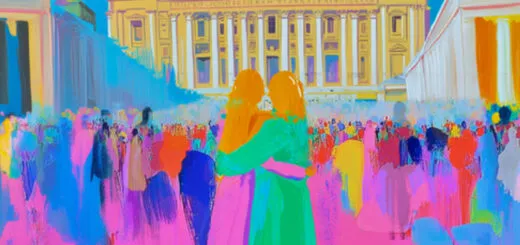
Walking with pride and faith: the pilgrims LGBTQ+ on the way on the Via Francigena


Text by Elisa Belotti*, published in New Ways Ministry (United States) on September 23, 2025. Freely translated by the volunteers of the Gionata project.
While most of the people who participated in the Jubilee LGBTQ+ at the beginning of this month they arrived in Rome by plane, train or bus, about thirty pilgrims chose a different, older and traditional way: reaching Rome on foot, along a thunderous and sacred pilgrimage path, the Via Francigena del Sud.
This path is part of an even longer itinerary that begins in England. The best known part of the Via Francigena starts from Canterbury and has been led to Rome since the 6th century. From there, some medieval travelers continued to Jerusalem, walking along the Appia to Santa Maria di Leuca, Puglia, from where they embarked on the Holy Land. The Via Francigena del Sud coincides with this second part of the journey. The LGBTQ+ group started its journey from Terracina, south of Rome.
In nine days they traveled 140 kilometers, arriving in Rome on September 5 for the pilgrimage vigil in the Church of the Jesus. They walked because of their experience as people or that of their loved ones.
The author Of Bondings 2.0, Elisa belotti, collected some of their testimonies.
Lorenzo Albano
Lorenzo Albano, who lives in Bologna, explained his choice as follows: «Via Francigena Is A beautiful journey, full of nature, culture and history. i was Curious to find out and i decided to get to Rome on foot.
I believe that they also physically question yourself to put order to put order in things, in priorities. Walking allows you to breathe, feel and let go of what is superfluous but often weighs in everyday life.
Entering Rome after walking the Appia was exciting. Spiritually, in moments of silence I found peace. One step after another, the path filled my life of meaning. Walking is tiring: you have to use your energies well and not waste your breath.
It is not easy to explain, but I felt spiritually and grateful to me simply to be there. On the human level, sharing time with others is always beautiful, but doing it walking makes relationships more authentic. Walking you share important moments of one's life, present, past or future. Trust is born easily. I am happy that deep friendships were born. This experience linked us ».
He also underlined the importance of the rhythm: «Yes, he engraved a lot. Step by step the desire to be there grew and to live what was waiting for us. Everyone has its own pilgrimage and its pace: there are those who go faster, whoever slowly.
It can change many times in one day, for external or inner reasons. There is no right or wrong pace. The important thing is to continue walking. We expected those who needed more time and it was wonderful ».
Mauro Cerritelli
Mauro Cerritelli, who lives in Abruzzo, said: «For me to participate in the LGBTQ+ pilgrimage in Rome it was an act of freedom from the fears that I still took inside, even after the coming out. It was a personal but also cultural, social and spiritual step.
This pilgrimage has become a second coming out, in front of the whole company, in the largest city in Italy, Rome. I put all my energies in spreading the message of this Jubilee: the Church should be a house for everyone.
Along the way, our presence has become a living testimony, a true street evangelization, embodied in our bodies. This was my third pilgrimage and the second organized with the Christian project LGBT+, an Italian network of people of Fede Queer.
From Terracina to Rome, every step has been marked by meetings with bishops, priests, parishes and the methodist community. This ecumenical spirit has renewed both the Via Francigena of the South and the sense of a church that is really home for everyone ».
After fifteen years of commitment in Catholic action, a secular movement that supports the rights of the oppressed and the poor, Mauro concludes: «This pilgrimage marks a new beginning. I am grateful to pastoral operators and all the simple people who courageously support the dream of a church open to all, beyond every border ».
Sergio Caravaggio
Sergio Caravaggio, from Cremona, was the organizer of the first LGBTQ+ pilgrimage in 2017: «The first time we were about twelve people and we traveled the Via Francigena of the North, the best known in Italy. Since then we have walked every one or two years together. That of 2025 was the seventh pilgrimage ».
In 2017 the pilgrimage ended in St. Peter's Square, where pilgrims brought a sign written: "Gay and lesbian pilgrims greet Pope Francis". At the beginning, the Vatican police attempted to prevent its entrance, but in the end it allowed him. During the Angelus, Pope Francis simply greeted them as "pilgrims of the Via Francigena" and offered them rosaries.
On that occasion, the pilgrims made a wooden rainbow cross. That same cross was brought back to 2025, up to St. Peter's Square. At the beginning some Vatican volunteers wanted to prevent them from entry into the basilica, but others intervened saying: «It is your cross. He must enter with you through the Holy Door ». And so it was.
Yveline Behets
Yveline Behets, Belgium's Transgender Catholic Woman, told her choice to walk: «As Cattolica I had already decided to go to San Pietro on pilgrimage to live the Jubilee. I thought I was going by plane. But being also an excursionist, the pilgrimage on foot seemed to me a beautiful opportunity for a deeper spiritual journey.
As a transgender woman, in an important moment of my personal path, the possibility of living this pilgrimage together with other Christians - who so often undergo discrimination for their diversity - seemed to me a real call.
In addition to the physical and psychological aspects related to living my difference, this pilgrimage added a spiritual dimension: to feel the love of God for what they are, as well as for all his children, including LGBTQ+people. I also heard the call of God to share, through my reality, a word of liberation and life ».
After walking this Sacra via, Yveline expressed his hope for the Church beyond the Jubilee: «I hope that Christians, as an ecclesial community, learn to get to know each other better and respect the path of life of each. And that the institutional Church opens its eyes on human reality, welcomes it in all its diversity and finds the ground for a ministry inspired by the good news of Jesus Christ ".
*Elisa Belotti collaborates with Bondings 2.0 and deals with telling stories of people LGBTQ+ believers in Italy and abroad.
Original text: Walking with Pride and Faith: LGBTQ+ Pilgrims on the Via Francigena