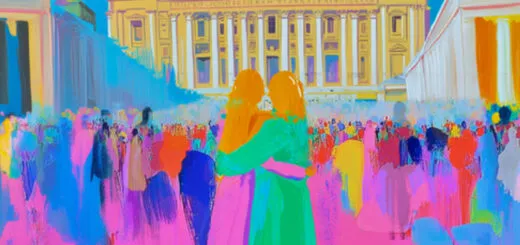
Chiavari. A small diocese with a deep church experience together with Christians LGBT+ and their family members
Transcription of the interventions held on the occasion of the laboratory "Build inclusive catholic pastorals: experiences in progress"Held in themeeting "corner Stones" (Florence, April 5, 2025), transcription by the volunteers of La Tento di Gionata, second part
After Bologna, the contact person of the pastoral care of the diocese of Chiavari takes the floor, who presents himself with simplicity: "We are a younger sister". Smaller as a diocese, and with a much more recent pastoral history than that of Bologna. But it is precisely from this dimension of fragility that something deep is born. Perhaps just like a bare ground, but available to be fertilized.
At the beginning from the nearby diocese of Genoa in which a group had already been active for some years (Bethel), founded by a presbyter, who disappeared prematurely, which is accompanied, but never officially recognized by the diocese.
In this group, the responsibility had been assumed by Laura who, during the Pandemic period, discovers the parish priest of Rapallo (of the nearby diocese of Chiavari) and some families who were questioning some questions of faith regarding their homosexual children. At the same time the diocese of Chiavari, driven by the synodal journey and believing us, wishes to rethink the family pastoral care by entrusting this path to a new director.
In 2022, in August, a small informal group was born, made up of friends, lay people and priests, who knew each other within the diocese and shared a common need: finding meaning in their belonging to the Church, without feeling forced in roles or pre -established categories.
The starting point was not a project, but a personal confession: "I was born in the church and I love it, but today I feel wounded by it," said one of the founders. From that moment, everyone has started to tell their story - with gratitude but also with pain - putting the experience of those who, like LGBT people, the divorced remarried people or the 'atypical' families, have never felt fully welcomed.
Get out of the categories, return to verbs
Questo è il cuore della proposta che nasce a Chiavari: non più categorie statiche, ma verbi dinamici. L’esperienza del vivere si scopre come eccedente le categorie o gli schemi che fino ad ora abbiamo elaborato. Proprio per questo la vita ci espone al sacro ed è un’esperienza incandescente. “Non partiamo più da definizioni come ‘sposato’, ‘divorziato’, ‘omosessuale’, ‘genitore’, ma dai verbi della vita che tutti condividiamo: nascere, crescere, amare, soffrire, morire”. Non esiste più l’immagine chi è dentro o fuori i confini della Chiesa, ma tutti cercatori indomiti del volto di Dio.
La pastorale, non è un’attività da gestire, ma un modo di camminare con gli altri, riscoprendo la bellezza di essere compagni di viaggio nella fede.
Un momento chiave di questo percorso avviene il 9 giugno 2023, quando alcuni rappresentanti della diocesi di Bologna vengono invitati da tutta la diocesi, dal vescovo e quindi dall’ufficio di pastorale famigliare nel cortile del Seminario a raccontare la loro esperienza (Siamo più di 200 persone, laici e presbiteri).
Ne nasce un incontro forte, profondo, che lascia un segno indelebile. “Non ci interessava organizzare una conferenza a tema. Ci interessavano le storie, i volti, i vissuti”, spiegano. “Ed è lì che la nostra Chiesa ha cominciato a cambiare”.
Una rete che cresce
From that meeting, a network started involving youth groups, pastoral offices, parish communities with their parish priests, various movements (in particular Focolarini, CL). The stories heard began to circulate within the Zonal or Vicarial Pastoral Councils, and from there small experiences of service and reception were born.
One of the most beautiful fruits was the group "Love on the way", which is a structural part of the family pastoral office of the diocese, designed to accompany couples and families on non -canonical paths. "For us - they say - it was a gift. Even those who had always felt on the margins found a space to be welcomed".
There is also a profound reflection on the term "inclusion". One of the speakers says forcefully: "I don't like the inclusive word. Not because it is wrong, but because it sounds as if I were the good that someone else includes. Instead, I am saved in turn by those who walk next to me. This is the real gift: to be transformed by the relationship".
The challenge launched by the diocese of Chiavari is strong and clear: to get out of the logic of the labels, enter the logic of relationships. It is not a question of "doing Pastoral LGBT", but of giving a profound experience of the church together, welcoming all and all in the paths of real life.