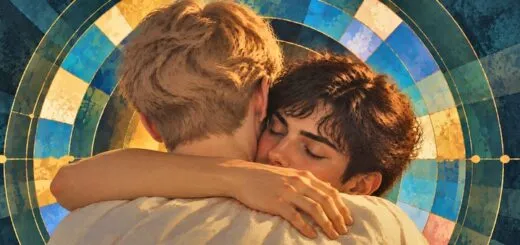
Daniela. By taking care of her I realized I loved her
Daniela's testimony Taken from the book edited by Elisa Belotti*,I trust you. Listening to LGBT+ Christian people and their parents, published by Jonathan's tent, march 2026, pp.9-13
I am sixty years old, I am the mother of two boys, I have a separation behind me and about five years ago my life was crossed by an unexpected relationship that made me rediscover parts of myself that I thought I had forgotten. All this has a name and a face at the center: Roberta.
It wasn't the first time I interacted with a trans person. I met my friend Roberta because we followed both proposals from CETEC (European Theater Center and San Vittore Women's Prison). With the project dedicated to female prisoners I discovered new friends. We met first on social media and then live through shows. Here I came into contact with some binary and non-binary trans people, including Roberta, and these meetings led me to ask myself many questions.
Roberta profoundly influenced my path. His is a story of pain, but also of enthusiasm, joy and great proactive strength. It allowed me to watch its journey from the beginning to today: a transformation that I feel is a wonder, almost a miracle. He is a person who has shaped himself.
In August 2020 she suffered a banal and disastrous bike fall that left her quadriplegic. I made myself available to be close to her and raise a family around her.

Over time, taking care of her, I realized I loved her. On this journey I was not alone: my children helped me assist her during her hospitalizations, as did a friend and neighbor and also a colleague.
Other people from the LGBTQ+ community made themselves available and present. People who donated their time without fanfare. I recognized in them, in their closeness, in their support the traits of the community that accompanied me in my adolescence on my growth journey.
It was a personal journey, in which I sought help and a community dimension. Ever since I was a girl, living in the parish, I had understood how essential the community was as an expression of the Christian faith. In supporting my care and love for Roberta, the network of people around us demonstrated to me once again the importance of mutual support also from a Christian perspective.
With Roberta I also experienced the confrontation with death. She risked dying several times and we shared moments of great fragility. It was an intense experience, even spiritually, during which I prayed a lot.
In those days I discovered that what I felt for her was called love and I started to question myself about who I was. Thanks to the local Christian LGBTQ+ community I met people who helped me name what I was experiencing, resolve my doubts and find new words to describe myself.
For example, reading Valentina Petrillo's book [6], I understood that I was pansexual and demisexual. I finally understood why I had fallen in love with Roberta, after always believing that I only liked men, and I also recognized a divine dimension in this journey. If this woman appeared on my path, Someone must have put her there, I have no doubt.
At this stage i also came into contact with the service I trust you.
I was looking for support and closeness, someone to help me feel Right. being reassured about the goodness of what i was experiencing was exactly what i needed at that moment in my life.
Then, by participating in the Friday masses in the Lazzaretto Church in Milan, once a month, I started to meet many people, discovering beautiful and deep relationships that made me feel welcomed. Roberta also came with me once and all the people present were really welcoming to her and to us. Here I feel at home, at home. I know I am welcomed with all my differences.
Durante questi incontri ho conosciuto anche Alessia Nobile[7], che mi ha aiutata a comprendere meglio l’esperienza delle donne trans e quanto il contesto sociale sia respingente, discriminante. Ma anche che avere fede è un diritto e ho fatto mio questo messaggio. Roberta ha sofferto molto per questo. Il suo dolore mi ha insegnato quanto sia urgente costruire spazi di cura, di ascolto e di fede vissuta, capaci di tenere insieme verità, amore e giustizia.
Io e Roberta siamo state insieme quattro anni. A un certo punto ci siamo anche fatte una promessa, suggellata da un anello. Era un regalo del mio ex marito, che ho smontato e rimontato per dargli una nuova forma, quindi aveva anche un significato trasformativo. Ci siamo promesse fedeltà nella gioia e nel dolore, in salute e in malattia. È stata la promessa più vera che io abbia mai sentito.
All’interno della mia fede cattolica, però, questa promessa mi ha portata anche a molti sensi di colpa. D’altronde avevo già fatto una promessa al padre dei miei ftgli nel sacramento del matrimonio. Con il tempo, anche grazie alla consapevolezza che non c’era più un sostegno reciproco, ho sentito di essere sciolta da quel vincolo. Le sensazioni di colpa e di vissuto mancato hanno trovato pace nelle confessioni con don Armando Cattaneo [8].
Sono tornata a vivere l’Eucaristia e la Riconciliazione liberamente, con un nuovo slancio. L’amore per Roberta mi ha costretta più volte a mettermi in discussione. Avendo vissuto sulla sua pelle il rifiuto sociale, mi ha chiesto più volte se mai mi fossi vergognata di farmi vedere con lei. Mai, mi sono sempre presentata prima come l’amica e la sorella, poi come la ftdanzata o la compagna di Roberta. Ho imparato a metterci la faccia, a espormi senza nascondermi.
La nostra unione è stata anche benedetta durante il Pride, un momento davvero emozionante. Dopo la separazione pensavo di aver sepolto il mio cuore e invece Roberta è riuscita a tirarlo fuori, a farmi provare di nuovo emozioni forti e tanto bene.
Ho portato Roberta anche nella mia famiglia d’origine. All’inizio l’ho presentata loro come mia amica e i miei genitori erano contenti. Quando hanno intuito che dopo la caduta si era trasformata in una relazione d’amore, per un periodo mio papà non mi ha parlato.
Ho dovuto metterci la faccia anche lì, fare un lavoro di riavvicina- mento. Li avevo sempre creduti persone libere e mi sono dovuta scontrare con dei limiti. Le mie sorelle, invece, sono state molto disponibili. Hanno addirittura organizzato delle feste di famiglia vicino alla sua RSD[9] per coinvolgerla e farla sentire parte della nostra vita.
With my relationship with Roberta my life changed radically, even from a material point of view. I had to move house and I felt the need to leave work, so I turned everything around and moved near her, who in the meantime had moved into a new RSD.
He continues to live there today, in a room full of our photographers, but he is not happy. He has no friends in the facility and the other people hosted do not share his same desire to live. Roberta is a non-binary and quadriplegic person, much of her daily life is a continuous struggle against ableism, transphobia and architectural barriers; it is therefore waiting to be welcomed into a new structure.
This summer Roberta left me. I tried to get my life back in hand and I realized that until she has a more suitable location I want to stay close to her at least as a friend. So today we live in a friendship relationship made up of ups and downs, with some fractures, but my affection for her has never wavered. Of course, this is a very difficult moment, a relational earthquake in which I feel great support from the believing LGBTQ+ community.
Belonging has become fundamental for me, as has the need to bear witness and be in solidarity. If I can make my person a gateway, a space of passage and welcome, I feel it is right to do so, to show my full support for all LGBTQ+ people.
Today this story is an open wound, because I wanted a life together with her. However, remaining anchored to my faith, I try to continue to see the beauty, to move forward.
I continue to believe that God put her in my path and that, in those four years together, life got better for both of us. With her I rediscovered the ability to love, the courage to live in a relationship, to defend my ideas and my beliefs.
_________________
* Elisa Belotti is a journalist and teacher, she deals with human rights and marginalized communities, with particular attention to the impact of religion on society. ForThe Revue, wrote comic investigations on religion class at school, violence against religious women and womenconversion therapies. She is the author ofWithout mills,A newsletter on Christianity around the world.
[6] Valentina Petrillo is a visually impaired transgender sprinter. In 2024 she was the first transgender athlete to participate in the Paralympic Games. Together with Claudio Arrigoni and Ilaria Leccardi he wrote faster than time. The journey of the first transgender athlete towards happiness, Capovolte, Alessandria, 2024.
[7] Alessia Nobile is a trans believer activist originally from Palo del Colle (BA). She was the first trans woman in Puglia to have her documents rectified without undergoing gender affirmation surgery. He wrote The Invisible Child, Castelvecchi, Rome, 2022.
[8] Armando Cattaneo is a priest of the diocese Of milan close to LGBTQ+ believing groups, in Particular Il guado and Giovani del Guado.
[9] Acronym indicating the healthcare Residence For disabled, A residential facility intended for people with disabilities.