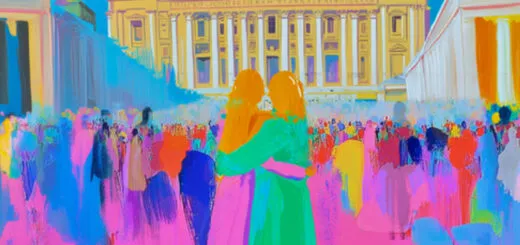
With our life we testify in the church that our love has the same dignity as any other love
Testimony of Fabiana and Luana del christian group LGBT+ Sicily during the prayer vigil "Church home for all, starting from borders" to participants in thejubilee pilgrimage of "La Tenda di Gionata and the other associations"In the Church of the Jesus of Rome on 5 September 2025
We are Fabiana and Luana. We fell in love four years ago, during a meeting of LGBT Christians. Our story began as many, a look that made the heart beat stronger than usual. We enjoyed, known, and slowly we decided to walk together, feeding our love every day.
In our relationship, faith is an important aspect and in everyday life we try to know and follow the will of God on our life, considering ourselves the gift of the other. For this reason it is difficult for us to accept that our love can be seen as a shame.
Who knows how Bartimeo felt when, in the desire to meet Jesus, he was reproached to keep silent. We too have experienced the judgment and reproach of people: we must not bother, we must not exist, we must continue to be at the edges of the road, invisible, so as not to disturb anyone, so as not to question the consciousness of those who, from the top of their integrity, honor the Lord.
Like that time, when i introduced Fabiana to my parish Priest. after listening carefully, he sought words of welcome, but what remained of that interview was his recommendation not to say anything to the community, because he was not ready to deal with this theme. it is better to Keep silent, to remain invisible.
Or when we were sitting in a bar together with a consecrated friend of mine that I haven't seen for some time. I wanted to introduce him to Fabiana, tell him about our love story. In fact, when something beautiful happens in life, the first instinct is to share it with loved ones.
We talked about the most and the least, until he, in affectionate tone, decides to give me advice: "Maybe that photo on your social profile, in which you kiss you, is too much. It would be better to avoid certain externalizations." Those words, although they gave gently, fell on me like a sudden shadow. As if our love should remain hidden, behind a tent pulled, far from the looks, as something not to talk about. In a nutshell, we were asked to hide.
In these and in other moments we felt like Bartimeo, silent by a church that would take us on the margins. A church that looks at our hands intertwined with embarrassment, which considers our kisses, castles, tender, as something that should never see the sunlight.
Yet, like Bartimeo, we cry out with our life that our love has the same dignity as any other love.
We feel that our relationship completes us, not because we are two half to gather, but because we help each other to become more whole. Where I do not arrive, she comes, and vice versa. Our love is a shy, but authentic, reflection of the love of God, who welcomes us and loves us as we are.
If there is one thing we have learned in these years, it is that you have to have someone next to you who help you get better.
Like many Christian couples, we also feel the desire to form together on the path of faith. For this reason, for two years, we have participated in a popular reading path of the Bible, accompanied by pairs of parents of LGBT people. People who first guided premarital courses in their parishes, and today they feel that God calls them to be a gift for us too. Thanks to this experience we mature more and more the awareness that Luana and I are called as a couple to live a life of loyalty, mutual care and donation.
And it is precisely within this path that we have understood how much wealth we can be for the Church.
We are not an exception to be tolerated or a problem to be managed. We are a living presence, a part of the body of the Church. We bring with us a profound experience of faith that resists despite the refusal, a testimony of love that flourishes even where everything seems to tell us that we are not entitled to it. We are wealth because being a minority gives us new eyes to look at the pain of others. It makes us capable of understanding who remains on the margins, because when you have been on the margins, you learn to look with different eyes who still remains excluded today.
For this reason, our dream is that one day the love between two people of the same sex, lived in loyalty and faith, can be recognized by the Church as a sign of the presence of God. In the heart of the Jubilee, our hope is to be looked at with the eyes of Jesus, which does not go further, but stops. That does not silence, but listens. Who is not afraid of touching, of welcoming, of blessing.
Like Bartimeo, we too cry so that the eyes of the Church will pose on us and recognize us disciple loved, living part of this path.